
A caravan pre-trip checklist is a set of safety, legal and reliability checks on your caravan and tow vehicle, done before you leave. For summer touring, it covers eight areas: the coupling and safety chains, brakes and lights, tyres and wheel bearings, weight limits, gas, 12V power and water, seals and awning, and fire safety. Start four to six weeks before departure, check again the day before and on departure morning, and recheck at your first stop.
Quick Answer: What To Check Before Summer Touring
- Coupling and chains: coupling locked on the ball, chains crossed, rated shackles closed.
- Brakes and lights: controller working, breakaway system charged, every light tested.
- Tyres: at least 1.6 mm tread, same construction on all wheels, pressures checked cold.
- Wheel bearings: no noise, wobble, grease leaks or hot hubs; serviced in the last 12 months.
- Weight: loaded van within its ATM, the car’s towing capacity, the towbar rating and the car’s GCM.
- Gas: soapy water leak test, cylinder in-test date, hoses and regulator undamaged.
- Power, water and seals: batteries charged, fridge pre-cooled, tanks and seals leak-free.
- Fire safety: extinguisher, fire blanket, smoke and carbon monoxide alarms, Total Fire Ban rules checked.
Bottom line: do the owner checks yourself, and leave bearings, brake adjustment, gas fitting and 240V work to a qualified workshop
Important Caravan Safety Numbers
| Key number | What it means |
|---|---|
| 1.6 mm | Minimum tyre tread depth (VicRoads) |
| 750 kg GTM | Trailers over this weight need brakes |
| 2,000 kg GTM | Over this, brakes on all wheels and automatic breakaway braking are required |
| 2,500 kg ATM | From this weight (up to 3,500 kg), two safety chains are required |
| 1.5 × ATM | Suggested minimum break load for safety chain shackles (VicRoads) |
| 8 to 10% of ATM | Tow ball download guide, within the towbar limit (WA Department of Transport) |
| 10 years | LPG cylinders must not be refilled if untested for longer than this (CFA) |
| 1 kg per litre | Weight of water in your tanks |
| 4 to 6 weeks | When to start preparing for a summer trip |
| 1 to 2 hours | Typical Focus RV pre-trip inspection time |
What Is a Caravan Pre-Trip Check?
A caravan pre-trip check is a focused safety inspection completed before travelling. It helps identify problems that could lead to a breakdown, accident or unexpected repair.
It sits between routine owner checks and the deeper annual caravan service.
| Check type | Who does it | When | What it covers |
|---|---|---|---|
| Owner pre-trip check | Caravan owner | Before each trip and at stops | Visual and functional checks |
| Professional pre-trip inspection | Workshop | Before long trips | Safety items checked by technicians |
| Annual caravan service | Workshop | Typically every 12 months | Full maintenance, including bearings and brake adjustments |
For summer trips, most owners benefit from all three.
Why Does Summer Touring Need Extra Checks?
Summer combines vans coming out of winter storage with heat, fire season, storms and busy roads.
Storage wear: grease thickens, seals harden, tyres crack or flat-spot, and batteries lose charge. If your van has been in caravan storage for a long period, plan a more thorough check.
Heat: hot roads raise tyre temperatures and pressures; batteries and solar regulators work harder; three-way absorption fridges can struggle to stay cold.
Fire season: Fire Danger Periods and Total Fire Bans restrict cooking and fire use, and conditions change while you travel.
Storms: sudden wind and rain test awnings and any seals that leaked over winter.
Busy roads: holiday traffic, long distances and hot days increase fatigue.
When Should You Do Each Check?
Start four to six weeks out for workshop jobs, then do owner checks one week before, the day before, on departure morning and at the first stop.
Four to Six Weeks Before Departure
- Book a professional pre-trip inspection, or your annual service if it is due. Summer is a busy period for workshops.
- Check your caravan and car registration, insurance and roadside assistance.
- Confirm your planned load fits within your weight limits.
- Order replacement parts such as tyres, hoses or a gas cylinder swap.
One Week Before
- Do a short test tow, especially if the van is new to you or has been stored.
- Charge house batteries fully and test the solar system.
- Run the fridge and check that it cools properly.
- Flush and refill the fresh water system, and empty and clean the toilet cassette.
- Test the gas system for leaks.
- Open the awning and check it, then pack it away dry.
The Day Before
- Check tyre pressures cold, including the spare.
- Check lights, coupling hardware and safety chains.
- Pack, putting heavy items low and close to the axles.
- Check fire safety equipment and test the smoke and carbon monoxide alarms.
Departure Morning
- Unplug the van’s power lead and stow it.
- Wind up the stabiliser legs and put the handle away.
- Hitch up, then stow the jockey wheel or lock it in the raised position.
- If you use a weight distribution hitch, connect it and check the car and van sit level.
- Run the walk-around check (see the quick checklist below) and test the brakes at low speed before reaching the main road.
First Stop
VicRoads recommends stopping soon after you set off to check everything is still secure. Look at the coupling, chains, wheel nuts and load. Carefully feel near each hub for unusual heat, and check tyres for anything that has changed.
The Caravan Pre-Trip Checklist
Work through each system below; each section starts with what matters most.
Coupling, Safety Chains and Shackles
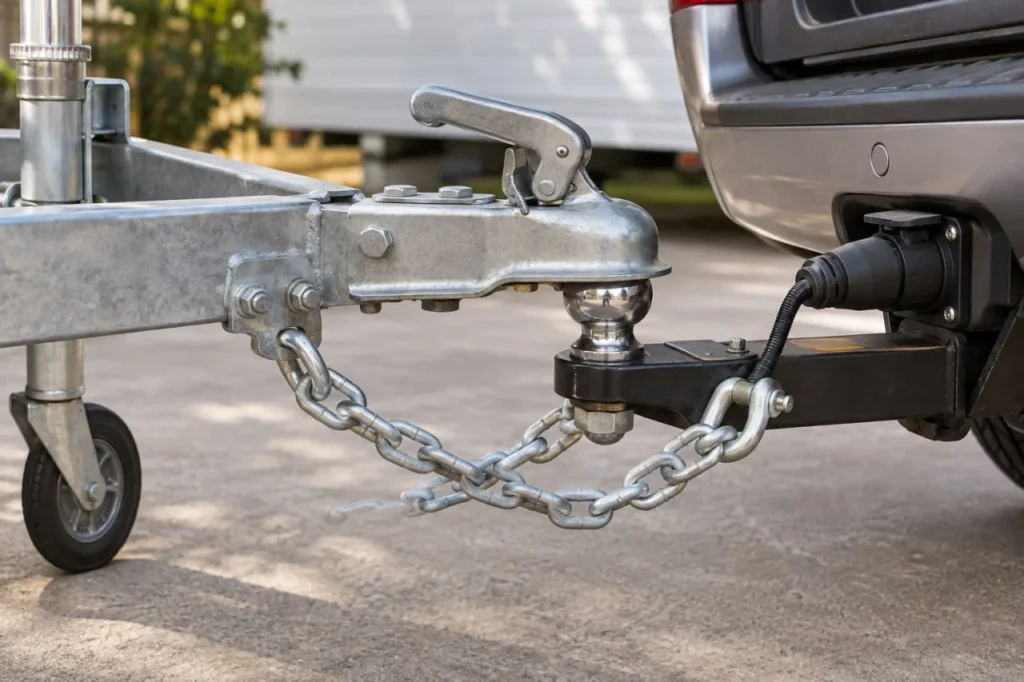
The coupling must lock fully onto the ball, with compliant chains crossed underneath.
- Check the coupling and tow ball for wear, cracks and correct size match.
- Make sure the locking mechanism engages.
- Inspect safety chains for stretched, worn or damaged links. Chains for light trailers should be marked as compliant with AS 4177. Caravans over 2,500 kg ATM need two chains.
- Attach chains crossed under the drawbar, and keep them short enough that the drawbar cannot hit the road if the coupling fails.
- Use suitable D shackles. VicRoads says load-rated shackles are not mandatory but are a good idea, with a break load limit at least 1.5 times the caravan’s ATM.
- Check the jockey wheel winds and locks properly, and raise it fully before driving.
Brakes, Breakaway System and Lights
Brakes, the breakaway system and all lights must work before every trip. Most touring caravans use electric brakes operated by a brake controller in the tow vehicle. Under Vehicle Standards Bulletin 1 (VSB1), the national standard for light trailers built to the Australian Design Rules, trailers over 750 kg GTM need brakes, and mechanical override brakes are only allowed up to 2,000 kg GTM. Over 2,000 kg GTM, brakes must act on all wheels and apply automatically if the van becomes detached.
- Check the brake controller powers on, shows no fault, and is set to suit the loaded van.
- Do a low-speed brake test in a quiet street or driveway before heading out.
- Check that the breakaway battery is charged and the pin and cable are in good condition.
- Test every light with a helper: tail lights, brake lights, indicators, number plate light and clearance lights.
- Check the trailer plug and socket for corrosion, bent pins and damaged cables.
Important to know: VicRoads states your caravan must be registered and roadworthy to be towed, nothing can be towed behind it, and no one can travel inside it while it is moving.
Tyres and Wheels
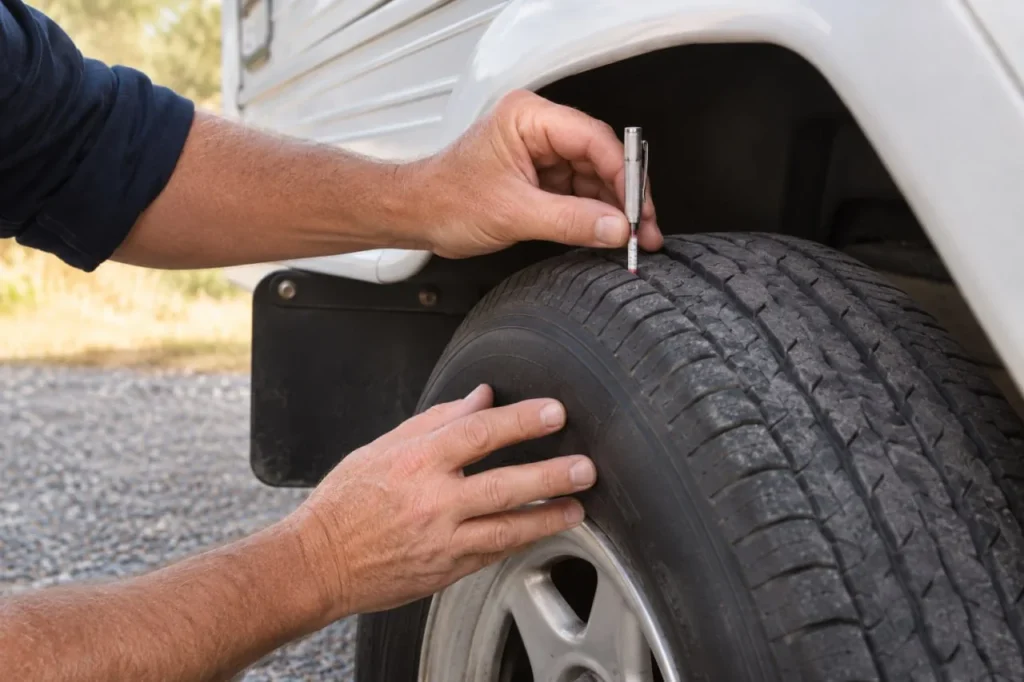
Every tyre needs at least 1.6 mm of tread, the same construction on all wheels, and correct cold pressures.
- Check tread depth against the VicRoads 1.6 mm minimum.
- Look closely at the sidewalls for cracks, bulges, cuts or flat spots, especially after long storage in the sun.
- Check pressures when the tyres are cold, using the tyre placard or the caravan and tyre manufacturer’s recommendation for your load. Never let air out of a hot tyre; hot readings are normally higher.
- Check the tyre age on the sidewall date code and ask a tyre professional if the tyres look old or weathered.
- Check wheel nuts are tight.
- Inspect the spare: pressure, condition, and that it actually fits the caravan.
Wheel Bearings and Suspension
Wheel bearings need a workshop service every 12 months; your job is to spot the warning signs. If bearings run dry or wear out, they can overheat, seize and, in the worst case, cause a wheel to lock or come off.
- Lift each wheel slightly off the ground (safely, on a stable surface with the van chocked) and check for wobble or grinding when you spin it.
- Look for grease flung onto the inside of the wheel rim.
- At stops, carefully feel near each hub. One noticeably hotter than the others is a warning sign.
- Check springs, shackles and bushes for cracks, breaks or obvious sagging.
Weight and Loading
Your loaded caravan must stay within the caravan’s ATM, your car’s towing limits and the towbar rating (VicRoads). See Caravan Weights Explained below for every term.
Practical loading tips
- Water weighs about 1 kg per litre. Travel with fresh water levels that suit your trip.
- Put heavy items low and close to the axles, not at the front or rear extremes.
- Keep ball weight within the towbar and vehicle limits. Too little or too much can cause sway or poor steering.
- Secure everything so it cannot shift under braking.
- If you are unsure, take the loaded rig to a public weighbridge before a long trip.
Gas System
Test every gas connection with soapy water and never use outdoor gas appliances inside the van. LPG leaks can cause fire, explosion or carbon monoxide poisoning. Carbon monoxide is a colourless, odourless gas produced when fuel burns, which is why ventilation and a working alarm matter.
- Check cylinders for damage and their test date. CFA advises that LPG cylinders must not be refilled if they have not been tested for more than 10 years or are damaged.
- Check hoses and the gas regulator for cracking, perishing or damage, and check connections for worn or split O rings.
- Do a leak test: with the gas on and appliances off, apply soapy water to connections. Energy Safe Victoria recommends this method. Bubbles mean a leak.
- Light each appliance and check the flame and operation.
- Turn gas appliances off before you pull into a service station.
If you smell gas: Turn the gas off at the cylinder, open doors and windows, do not use flames or switches, and have the system checked by a licensed gas fitter before using it again.
12V Power, Batteries and Solar
Batteries should be fully charged, hold charge overnight, and have ventilation in the heat.
- Charge house batteries fully before leaving, and check they hold charge overnight. Lithium batteries have operating temperature limits set by their manufacturer, so check those specifications before touring in extreme heat.
- Check that the solar panel is clean and the regulator shows charging.
- Inspect battery terminals and cabling for corrosion, looseness or heat damage.
- Check that your vehicle charges the caravan battery while driving, if your setup is designed to.
Fridge, Water and Air Conditioning
Pre-cool the fridge for at least a day and make sure water and cooling systems work before you load food.
- Check external fridge vents are clear of dust, nests and debris. Good airflow matters most in hot weather.
- Flush and refill water tanks, then check the pump, taps, hot water system and for leaks under sinks.
- Run the air conditioner and clean or check its filters.
- Pack extra drinking water for hot, remote areas, but count its weight.
Roof, Seals, Windows and Awning
Check every seal for water ingress after winter, and carry awning tie-downs for summer storms.
- Look at roof sealant, hatch seals, window seals and door seals for cracks or gaps.
- Inside, check for musty smells, stains or soft spots in walls, floors and ceilings.
- Open the awning fully, check arms and fabric, and confirm you have tie-downs.
- Make sure windows, hatches, and the door lock securely for travel.
Fire Safety and Bushfire Season
Carry an extinguisher and fire blanket, test your alarms, and check Fire Danger Period and Total Fire Ban rules wherever you stay. A Fire Danger Period is declared for a municipality when fire risk rises, and open-air burning then needs a permit. A Total Fire Ban is declared for days when fires are likely to spread rapidly, and stricter legal limits apply.
- Check that your fire extinguisher is in date, charged and easy to reach, and keep a fire blanket near the kitchen.
- Test the smoke alarm and carbon monoxide alarm, and replace batteries if needed.
- Install the VicEmergency app and check fire warnings for where you are going.
- On Total Fire Ban days, solid fuel cookers such as wood, heat bead and charcoal barbecues are banned, and gas or electric barbecues can only be used under strict conditions. CFA treats cooking inside a caravan differently from cooking outside or in an annexe. Check CFA’s Can I or Can’t I guidance and its caravan fire safety advice before you cook outdoors.
- Have a plan to leave early if fire conditions turn dangerous.
Tow Vehicle
The tow vehicle needs to be serviced, fitted with suitable mirrors, and have a sound towbar and brake controller.
- Make sure coolant, oil, brakes and tyres are checked for towing in heat.
- Fit towing mirrors if you cannot see clearly past the van. VicRoads says extension mirrors must be removed when you are not towing.
- Check the towbar mounting bolts and tongue for damage.
- Check the brake controller wiring and the vehicle’s trailer socket.
Focus RV installs towing and safety accessories such as tow mirrors, weight distribution hitches, brake controllers, breakaway switches and reversing cameras
INTERSTATE TRIPS VicRoads notes some towing laws differ between states. If you are crossing borders this summer, check each state’s rules, such as the NSW Government towing guidance.
Caravan Weights Explained: Tare, ATM, GTM, GVM and GCM
Caravan weight limits come from the manufacturer: the caravan’s are on its compliance or VIN plate, and the car’s are on its compliance plate and in the owner’s manual. The definitions below follow the Department of Transport (WA) Safe Towing Guide.
| Term | What it means | Where to find it |
|---|---|---|
| Tare mass | The caravan’s empty weight, before water, gas and gear. | Caravan compliance or VIN plate |
| Aggregate Trailer Mass (ATM | The maximum the loaded caravan may weigh. ATM equals GTM plus tow ball download. | Caravan compliance or VIN plate |
| Gross Trailer Mass (GTM) | The weight carried by the caravan’s own tyres when hitched and fully loaded. Always lower than ATM. | Caravan compliance or VIN plate |
| Payload | How much you can load: ATM minus Tare. It must not be exceeded. | Calculate from the plate |
| Tow ball download (ball weight) | The weight the coupling puts on the tow ball. Guide: 8 to 10% of ATM, within the towbar limit. Some designs need less. | Weigh at the coupling; limits on towbar plate and in owner’s manual |
| Gross Vehicle Mass (GVM) | The maximum the tow vehicle may weigh loaded. Ball load counts towards it. | Vehicle compliance plate or owner’s manual |
| Gross Combination Mass (GCM) | The maximum combined weight of car and caravan coupled. It can be less than GVM plus towing capacity. | Owner’s manual |
| Towing capacity | The heaviest caravan the vehicle is rated to tow. If the towbar is rated lower, the lower figure applies. | Owner’s manual and towbar plate |
Why GCM catches people out: a car with a 3,000 kg GVM, 3,500 kg towing capacity and 6,000 kg GCM can only tow 3,000 kg when the car itself is loaded to 3,000 kg. Heavy packing in the car reduces how much caravan you can legally tow.
What About the 85% Rule?
The 85% rule is a guideline from UK caravan clubs: keep the loaded caravan at no more than 85% of the tow vehicle’s kerb weight (its weight in running order with a full fuel tank, but no passengers or load). It is not an Australian legal requirement. The legal limits are the ATM, towing capacity, towbar rating, GVM and GCM above.
Which Checks Can You Do Yourself?
Owners can do visual and functional checks; bearings, brake adjustment, gas fitting and 240V work need qualified technicians.
| Task | You can check | Leave to a qualified technician |
|---|---|---|
| Tyre pressure, tread and sidewalls | ✓ | Tyre replacement |
| Lights, plug and wiring connections | ✓ | Wiring faults |
| Coupling, chains, shackles, jockey wheel | ✓ | Worn or damaged coupling |
| Brake controller and low-speed test | ✓ | Brake adjustment, magnets, linings |
| Wheel bearings (noise, heat, grease) | Spot the signs | Inspection, repacking, replacement |
| Gas soapy water leak test | ✓ | Any gas fitting or appliance repair (licensed gas fitter) |
| Battery charge and solar output | ✓ | 240V work (licensed electrician) |
| Seals (visual check) | ✓ | Water ingress testing and repairs |
| Weights (weighbridge or ball weight scales) | ✓ | Advice on load distribution and hitch setup |
Common Mistakes to Avoid
- Leaving it to the last week: a fault found two days before Christmas may not be fixable in time.
- Checking tyre pressure when hot: pressures read higher after driving.
- Filling every water tank “just in case”: it adds weight fast.
- Packing the car to the roof: weight in the car can push the rig over its GCM.
- Assuming a stored van is fine: storage itself causes wear.
- Skipping the first-stop check: many problems show up in the first 30 minutes of towing.
What Should You Carry in a Spares and Safety Kit?
Carry tools for tyres and wheels, electrical spares, safety equipment, water and your travel documents. Weigh the kit as part of your payload.
- Tyre pressure gauge and a 12V air compressor
- Wheel brace that fits the caravan’s wheel nuts, a jack rated for the van, and wheel chocks
- Spare fuses and bulbs for the van and car
- Gloves, a torch and a basic tool kit
- First aid kit, fire extinguisher and fire blanket
- Extra drinking water, sunscreen and hats for hot days
- Offline maps, roadside assistance details, and registration and insurance documents
- Caravan and appliance manuals
How Far Should You Drive Each Day in Summer?
Many caravanners follow the informal 3-3-3 rule: drive no more than about 300 km a day, arrive by 3 pm, and stay at least 3 nights. It is a guideline, not a law. Shorter driving days reduce fatigue, and arriving mid-afternoon gives daylight to set up and time to check tomorrow’s fire warnings. VicRoads also recommends practising on short trips first, leaving extra space behind the vehicle in front, and planning plenty of rest stops.
What Warning Signs Mean You Should Not Tow?
Do not tow until any of these signs have been checked:
- grinding, rumbling or squealing from a wheel
- one hub noticeably hotter than the others after a short drive
- grease on the inside of a wheel
- weak, grabbing or uneven braking, or brake controller error messages
- a gas smell, or bubbles in a leak test
- cracked, bulging or badly worn tyres
- the van swaying or pulling more than usual
- damp, stains or soft spots inside, suggesting a leak
Focus RV handles caravan repairs covering water damage, electrical, gas and appliance faults, and structural work.
Where Can You Get a Pre-Trip Inspection in Melbourne?
Focus RV Group offers pre-trip inspections at its Campbellfield workshop, covering brakes, bearings, tyres, gas operation, lights, battery and hitch, usually in one to two hours.
- A pre-trip inspection is a quicker check of the items most likely to fail on the road. It does not replace the annual service.
- A full service every 12 months is recommended, and a return-to-use service is recommended for vans coming out of 12 months or more in storage.
- Services come with a written report detailing what was checked, adjusted, replaced or flagged.
- The workshop services caravans, campervans, motorhomes, slide-ons and pop-tops.
The workshop at 1801 Sydney Road, Campbellfield is open Monday to Thursday 7 am to 3 pm and Friday 7 am to 2 pm. Book well before your departure date, especially in the lead-up to the summer holidays.
Quick Caravan Pre-Trip Checklist
Use this as your final walk-around on departure morning.
Hitch and Towing
- Coupling locked onto the ball
- Safety chains crossed, and shackles closed
- Trailer plug connected and cable secured
- Breakaway cable attached
- Jockey wheel raised and secured, stabiliser legs up
- Weight distribution hitch connected (if used)
- Towing mirrors adjusted
Wheels and Brakes
- Tyre pressures checked cold, including the spare
- Wheel nuts tight
- Brake controller on and working
- Low-speed brake test done
Lights
- Tail, brake, indicator and number plate lights working
Van Secure
- Power lead unplugged and stowed
- Gas off at cylinder for travel
- Windows, hatches, roof vents and door locked
- Awning secured, steps up, TV antenna down
- Load secured, heavy items low
- Fridge door latched
Safety
- Fire extinguisher and fire blanket on board
- Smoke and carbon monoxide alarms tested
- Fire warnings checked for your route
Conclusion
A safe summer trip depends on timing: workshop jobs four to six weeks out, owner checks in the final days, and a recheck at the first stop. Know your weights before you pack, and focus most on the coupling, brakes, tyres, weight and gas, where small problems become serious ones on the road.
Book a Caravan Pre-Trip Inspection
If you would like a technician to check the safety-critical items before your trip, book a pre-trip inspection or service with Focus RV Group in Campbellfield. Call (03) 8383 1026 or contact the Focus RV team.